Wall Oven Cutouts and Support Platforms: What Your Cabinet Needs
A wall oven isn't a drop-in swap — it needs a precise cutout and a load-rated platform built to carry real weight, and getting either wrong shows up the day it's installed.
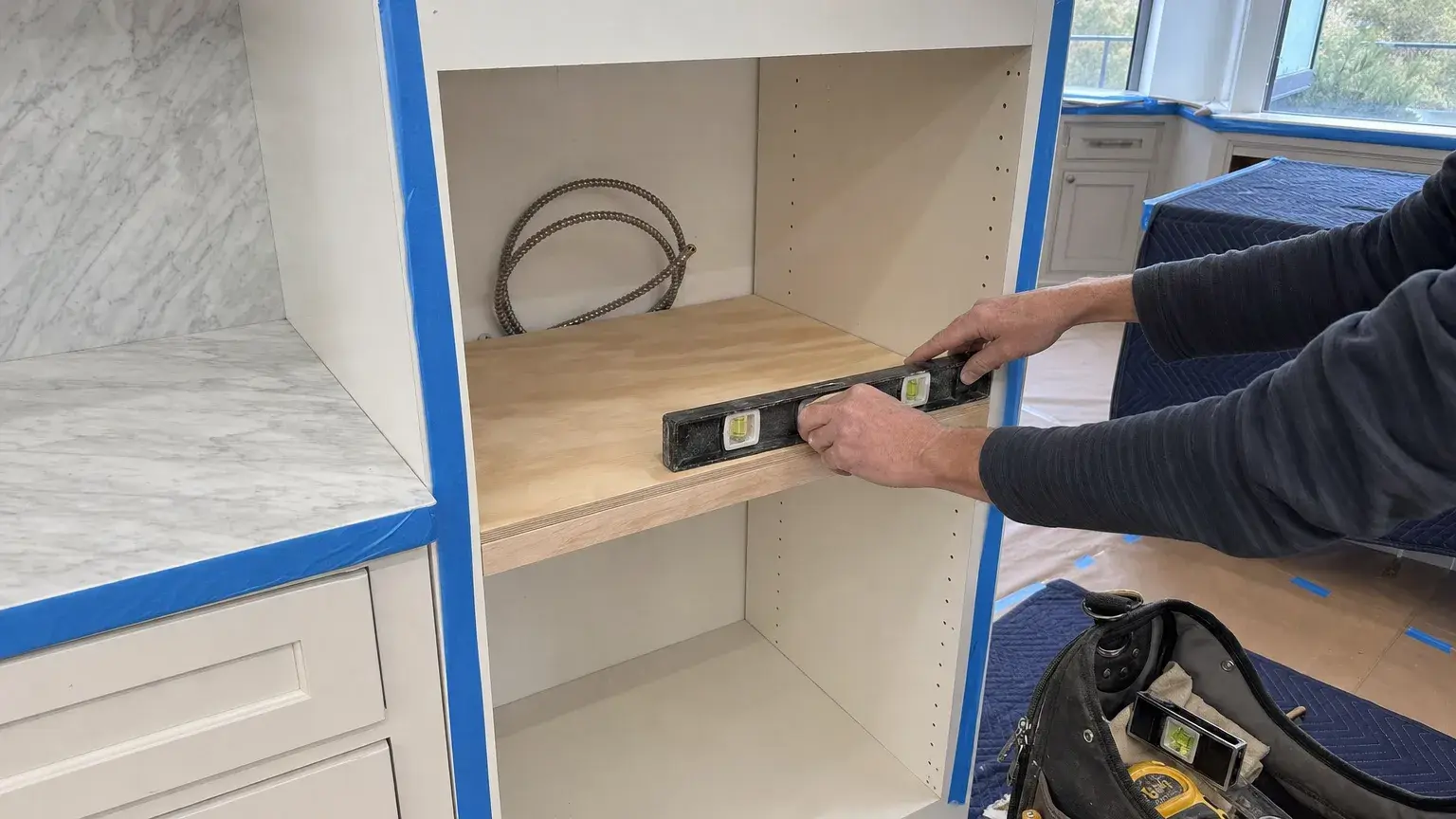
A wall oven looks like it should slide into its cabinet the way a book slides onto a shelf. It doesn’t. The unit is heavy, it runs hot, it has to sit dead level so the door seals and the controls land flush, and all of that weight has to be carried by something the manufacturer assumes is already built into the cabinet. When the old oven comes out and the new one goes to slide in, the gap between assumption and reality is where projects stall.
This guide walks through what a tall cabinet actually needs to hold a wall oven: the cutout, the platform that carries the load, the clearances that keep the door and controls usable, and the wiring behind it all. Read it before you buy, not after the box is on your kitchen floor.
Start with the cutout, not the oven’s outside size
Every wall oven has two sets of numbers in its installation manual: the unit’s own dimensions and the cutout (sometimes called the rough opening) it requires. They are never the same, and the cutout is the one that matters to your cabinet.
The cutout spec gives you three things:
- Cutout width — the clear width of the opening between the cabinet sides, behind the face frame. This is usually a fraction wider than the oven body so the unit slides without binding and the trim has room to land.
- Cutout height — the vertical clear space the oven body needs, measured from the platform up.
- Cutout depth — how deep the cabinet cavity must be, which also dictates where the back of the oven, its junction box, and any rear clearance for heat have to live.
Because cabinets settle and face frames drift, no opening is perfectly uniform. The tightest spot in the opening is the one that governs whether the oven slides home, so plan your working size around the narrowest point you find rather than an average. A cutout that’s a hair too tight isn’t fatal, but you want to know it now, because trimming a face frame or shaving a side is a planned cut, not a delivery-day scramble. The measure guide covers exactly how to take those numbers and where to put the tape.
The support platform is the part people forget
This is the single most overlooked requirement, and it’s the one that causes the most damage when it’s wrong. A wall oven does not hang from its trim. It rests on a horizontal platform inside the cabinet, and that platform carries the entire weight of the unit.
That weight is not trivial. A single wall oven commonly runs well past a hundred pounds. A double oven, or a wall oven with a heavy door and gas components, can climb toward three hundred. Put that on a thin shelf held by four plastic pins and you have a slow-motion failure waiting to happen.
A correct platform is:
- Load-rated — built from solid plywood or a comparable structural panel, not particleboard scrap or a decorative shelf.
- Fully supported underneath — fastened to the cabinet sides and the back, ideally with cleats or rails along the load-bearing edges so the weight transfers into the cabinet box, not just the fasteners.
- Sized to the cutout — deep and wide enough that the oven’s full footprint lands on it, with no overhang where the unit’s feet or frame would cantilever past the edge.
- Flat and square — because everything stacked above it inherits whatever twist the platform has.
If your old oven came out and you’re staring at a flimsy shelf or a chewed-up panel where it used to sit, treat that as a sign to rebuild the platform, not to reuse it. The next oven is only as solid as what’s under it.
Platform height controls whether the oven is usable
Getting the platform strong is half the job. Getting it at the right height is the other half, because that height decides whether you can actually use the oven and whether the door clears everything in front of it.
Controls and door
Most wall ovens put their controls and handle at the top of the unit. Set the platform too high and the controls end up above comfortable reach; set it too low and a double oven’s lower cavity becomes a back-breaker. Manufacturers publish a recommended range, and for a single oven a common target lands the controls in easy sightline for the people who cook there.
The door is the other constraint. A wall oven door drops down and out, and it needs:
- Clear swing in front, with nothing — a kitchen island, a perpendicular cabinet, a trash pull-out — inside the arc.
- Enough height below the cutout that the open door doesn’t foul a drawer or a toe-kick detail.
- Flush alignment so the closed door sits even with the cabinet face and the gasket seals all the way around.
A platform that’s even slightly off level will telegraph straight into the door: one corner gaps, the latch fights you, and heat leaks. Level here isn’t cosmetic.
Replacing an old oven with a different model
Swapping like-for-like is the easy case. The hard case — and the common one — is replacing a discontinued oven with whatever’s current, often from a different brand.
Expect the cutout to be different, sometimes by a little, sometimes by a lot:
- A new model may need a wider or taller opening, which means trimming the cutout and possibly reworking the face frame.
- A new model may be smaller, leaving a gap that needs filler panels scribed and fitted so the result looks built-in, not patched.
- The depth may change, which can move the platform, the rear clearance, or the junction box location.
None of these are dealbreakers, but they’re all carpentry. Resizing an opening cleanly, squaring it back up, and adding scribed filler so the trim sits tight is exactly the kind of work that separates a finished install from an obvious retrofit.
Double ovens, combos, and the weight that comes with them
Double wall ovens and oven-microwave or oven-steam combinations raise every stake at once:
- More weight, so the platform spec gets stricter and the fastening has to be genuinely structural.
- Taller cutouts, which can run into a fixed shelf, a drawer bank, or the top of the cabinet that has to be removed or rebuilt.
- Two heat sources, meaning ventilation clearances and trim allowances both matter more.
Don’t assume the cabinet that held a single oven will take a double. The cutout height alone often disqualifies it without modification, and the platform almost always needs upgrading.
Electrical behind the oven
Wall ovens are typically hardwired or run on a dedicated 240V circuit, and the connection lives in a junction box inside or behind the cabinet. Two things trip people up:
- The circuit has to match the new oven. Amperage and breaker requirements can change between models, and an undersized circuit isn’t a thing you work around — it gets corrected by a licensed electrician.
- The junction box has to stay accessible and clear of the oven body, with the supply whip routed so it isn’t pinched when the unit slides home.
We coordinate the carpentry around the electrical so the cutout, the platform, and the wiring all end up in the same plan instead of fighting each other on install day.
Why this isn’t a drop-in job
A wall oven sits at the intersection of three trades: precise measurement, real structural carpentry, and electrical that has to be right. The cutout has to be square and to spec, the platform has to carry serious weight at the correct height, the door and controls have to clear and seal, and the circuit has to suit the unit. Miss any one and the oven binds, gaps, or simply can’t go in.
A wall oven is too heavy and too unforgiving to learn its cutout, platform, and circuit on the fly. Have the cutout spec sheet for the exact model you’re considering, give us a call, and we’ll walk the opening with you — checking the cutout, the strength and height of the platform, and the circuit feeding it — before you commit to that oven. If you’d rather we put eyes on the cabinet in person, request a fit check and we’ll lay out what it needs in writing, so the carpentry, the lift, and the wiring are all settled long before the unit arrives.